Natural OS
As a Product Design Lead at Brain Technologies, I helped shape an award-winning, AI-first mobile experience built around a radically different interaction model: instead of navigating between apps, users express their intentions and the interface adapts to help them complete their tasks.
Company: Brain Technologies (company behind Natural OS) is a Silicon Valley AI company backed by investors including Laurene Powell Jobs's Emerson Collective.
Tenure: 2018 – 2022
Platforms: iOS
Awards: 2022 Red Dot Award in the category Best Mobile User Interface.
Number of users: ~1–3 million cumulative users (estimated for 2026)
Case studies: morphing interface and featured user flow case studies (both listed below).
Impact & Leadership Highlights
- Strategic Design Leadership: Partnered directly with the CEO Jerry Yue and CDO Gleb Kuznetsov to define and drive product design strategy from alpha through launch and growth, influencing core user experience and business outcomes.
- Customer-centric Innovation: Led research and competitive analysis to shape product vision against category leaders.
- Feature Definition & Validation: Scoped, prototyped, and iterated core user flows (grocery checkout, flight/hotel booking flows, rideshare ordering) balancing business priorities with usability and performance metrics.
- Evidence-based Decisions: Influenced product direction with quantitative and qualitative insights — including retention, conversion, task completion, behavioral analytics, and usability testing.
- Refined and extended the concept of morning interface. Interface that adapts to user input dynamically.
Core Responsibilities
- User & Market Research: Synthesized user needs and competitive insights to inform strategic design decisions and prioritize initiatives.
- Design Strategy & Ideation: Authored product strategy artifacts (onboarding, notification frameworks, purchase flows) that aligned UX goals with business KPIs.
- Information Architecture & Navigation: Designed scalable navigation systems and taxonomies that improved discoverability and reduced cognitive friction.
- Prototype Development: Crafted interactive prototypes to validate concepts with stakeholders and users, accelerating feedback loops.
- Usability Testing & Insights: Led remote usability sessions to uncover pain points and iterate high-confidence solutions.
- Cross-functional Collaboration: Delivered high-fidelity specs, redlines, and handoffs that enabled engineering to ship polished user experiences.
Tools & Methods
Figma, LLM training and data management, user research, A/B, multivariate and usability testing.
Case study 1: Designing the Morphing Interface
The Problem: Users have to adapt to apps
Traditional mobile operating systems are organised around applications.
Users need to know which app provides the functionality they want, open it, navigate through its interface, and sometimes switch between several apps to complete a single task.
This model introduces unnecessary friction, especially for activities involving multiple steps or services.
At Brain Technologies, we explored a fundamentally different approach.
What if users could simply express what they wanted to accomplish, and the interface adapted to their intentions instead of forcing them to navigate between applications?
This question became the foundation of Natural's morphing interface:
The Product Vision: Interface built around user intent
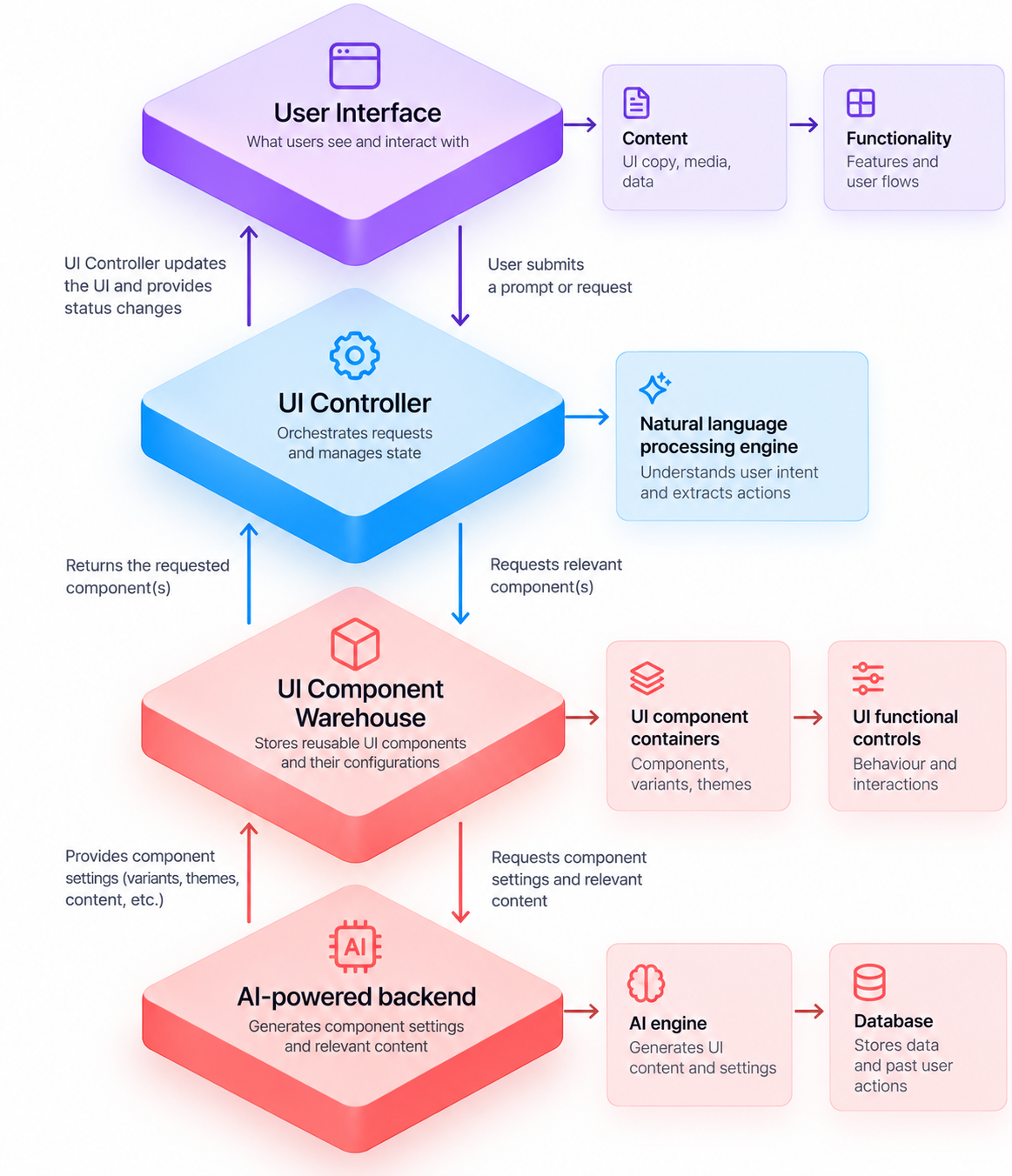
The morphing interface replaces the traditional model of navigating through predetermined screens with an experience that dynamically presents content & functionality relevant to the user's current task.
- Users can express their intentions through natural language, using text or voice input.
- The system interprets those intentions and generates a contextual interface that helps users move towards their desired outcome.
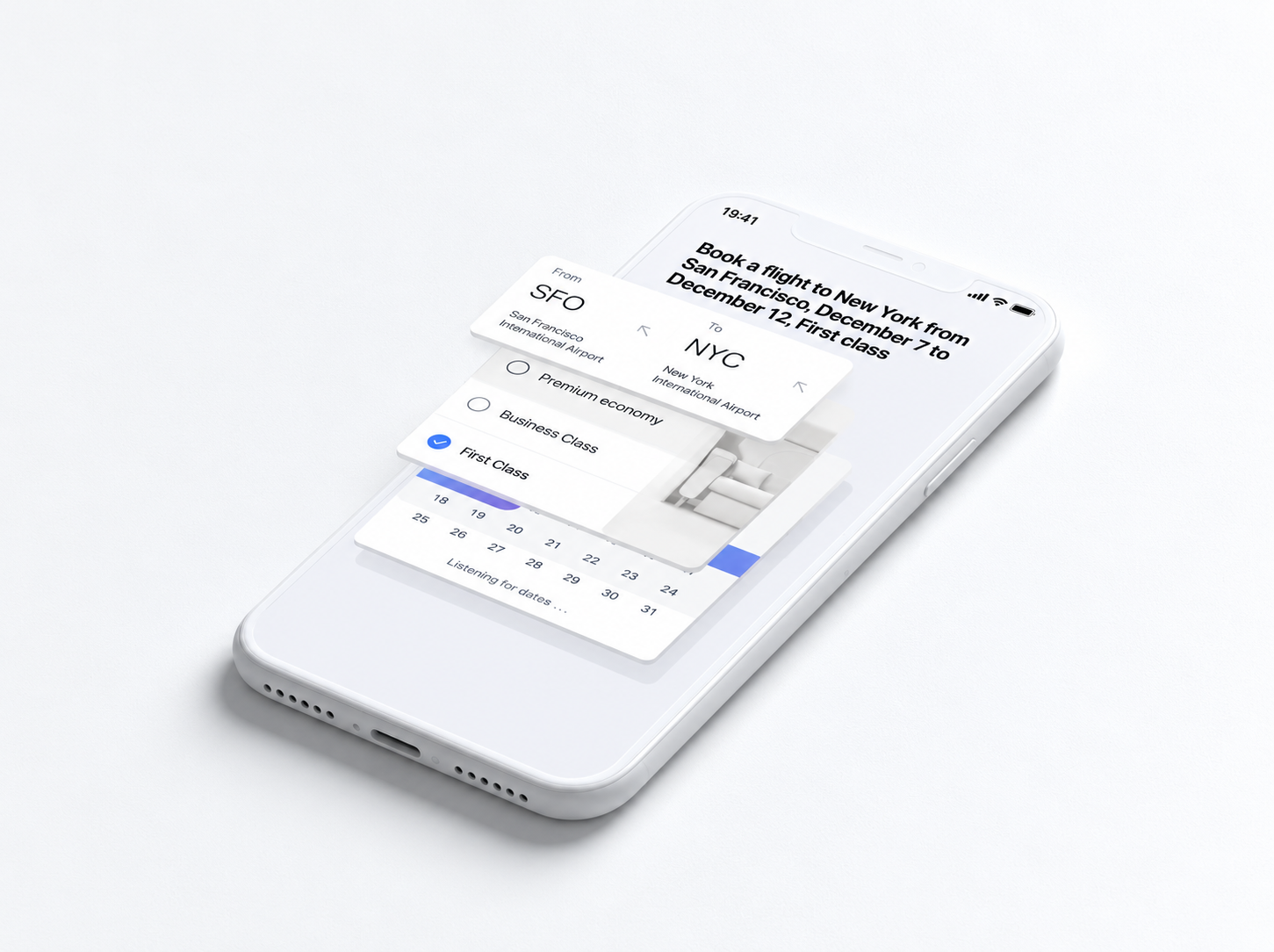
For example, a request to book a flight can produce a travel-oriented interface with relevant destinations, dates, flight options, and booking controls.
The goal was not simply to replace buttons with conversational input but rather to rethink the relationship between user intent, navigation, and interface structure.
Design Challenge 1: Balancing adaptability & predictability
One of the central challenges of a morphing interface is maintaining usability while the structure of the interface changes dynamically.
Traditional mobile interfaces benefit from predictable navigation, consistent controls, and familiar interaction patterns.
A dynamically generated interface introduces additional complexity: the available actions and information may change depending on what users ask the system to do.
My work focused on refining the morphing interface concept and creating interaction patterns that could support different tasks without sacrificing clarity and consistency.
This required thinking beyond individual screens and considering how the interface should behave as users move from one step of a task to another.
The key design principle was to make the interface adaptable to user intent while preserving familiar and reusable interaction patterns.
Design Challenge 2: Personalisation without sacrificing user control
Another important consideration was personalisation.
Users have different needs, preferences, and limitations. To deliver a relevant experience, Natural needed a way to adapt not only to the immediate request but also to the user's broader context (specific user needs and preferences).
I proposed combining adaptive personalisation with explicit user controls.
The AI engine could learn from user interactions and preferences, while a dedicated My Preferences section would allow users to review and customise information that influenced the experience.
This approach addressed an important design tension.
Automatic personalisation can reduce repetitive input, but relying entirely on inferred preferences risks making the system feel unpredictable.
Giving users direct control over their preferences offered a way to balance convenience with transparency and user autonomy.
The design direction was informed by the usability principle of User Control and Freedom, particularly the need to let users influence and correct the system's behaviour.
Case Study 2: Designing Complex User Journeys
The Problem: Turning a new interaction model into a useful product
Once the morphing interface concept began to take shape, the next challenge was translating it into practical experiences that users would have reasons to return to.
Alongside basic communication tasks such as making calls, sending messages, and composing emails, I proposed covering common consumer scenarios including shopping, food ordering, rideshare services, and travel booking.
These use cases were selected for two reasons:
- First, they represented meaningful user problems. Many everyday tasks require users to move between applications, provide similar information repeatedly, and navigate multiple steps before reaching their goals.
- Second, transactional experiences offered potential commercial value. Activities such as purchasing products or booking travel could create opportunities for Brain Technologies to generate revenue as the platform developed.
This connected the interaction model to both user value and business objectives.
Why I focused on flight booking
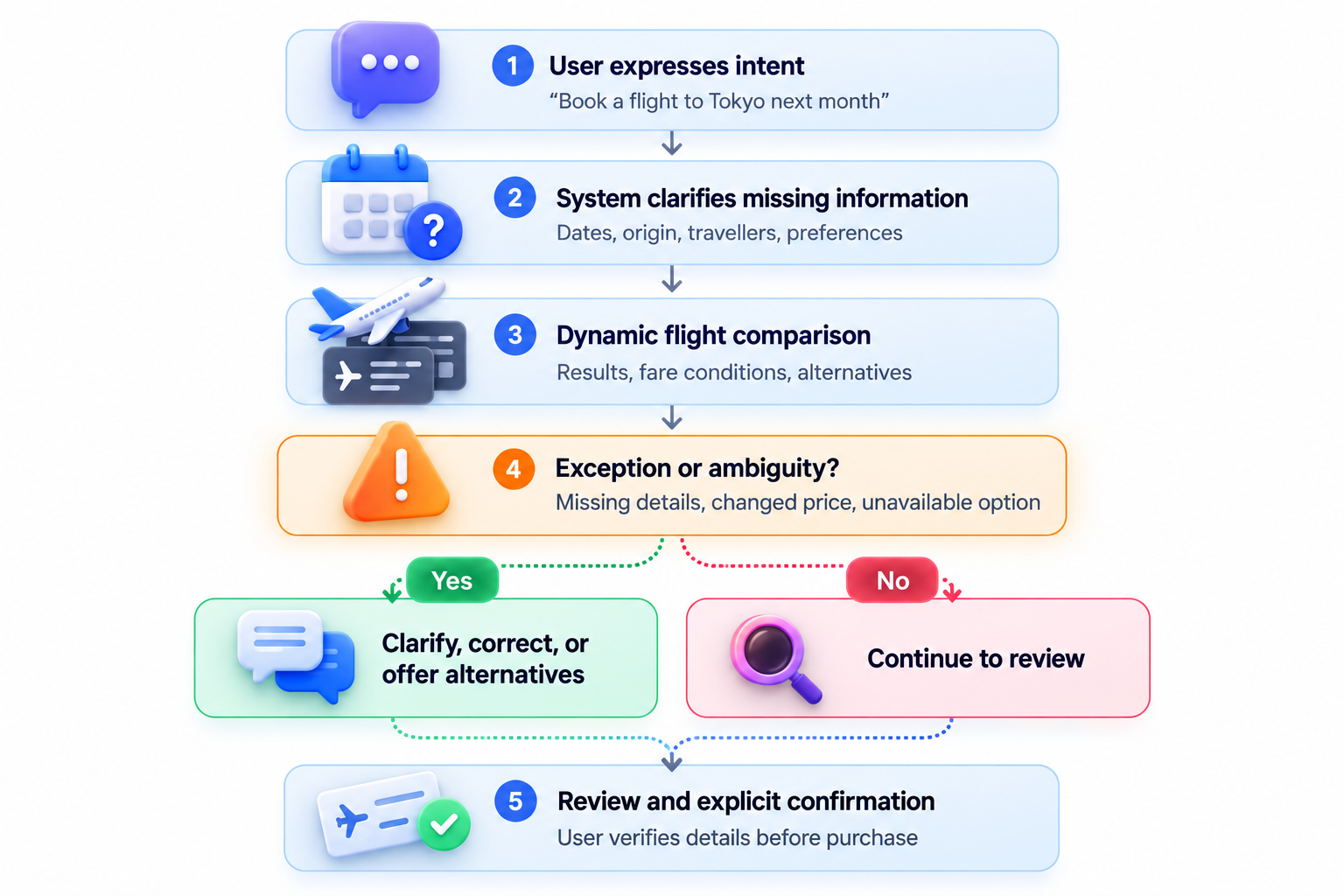
Flight booking was one of the most interesting scenarios because it combined natural-language interaction with complex, structured information.
A user might start with a simple request: “Book a flight from San Francisco to New York next Friday.”
However, successfully completing that task requires considerably more information than the initial request contains.
The system needs to support a sequence of decisions, including travel dates, available flights, passenger details, booking preferences, and confirmation.
It also needs to account for scenarios where the available information is incomplete or the user's requirements change.
This made flight booking a valuable use case for exploring how a dynamically generated interface could support complex tasks.
Designing beyond the happy path
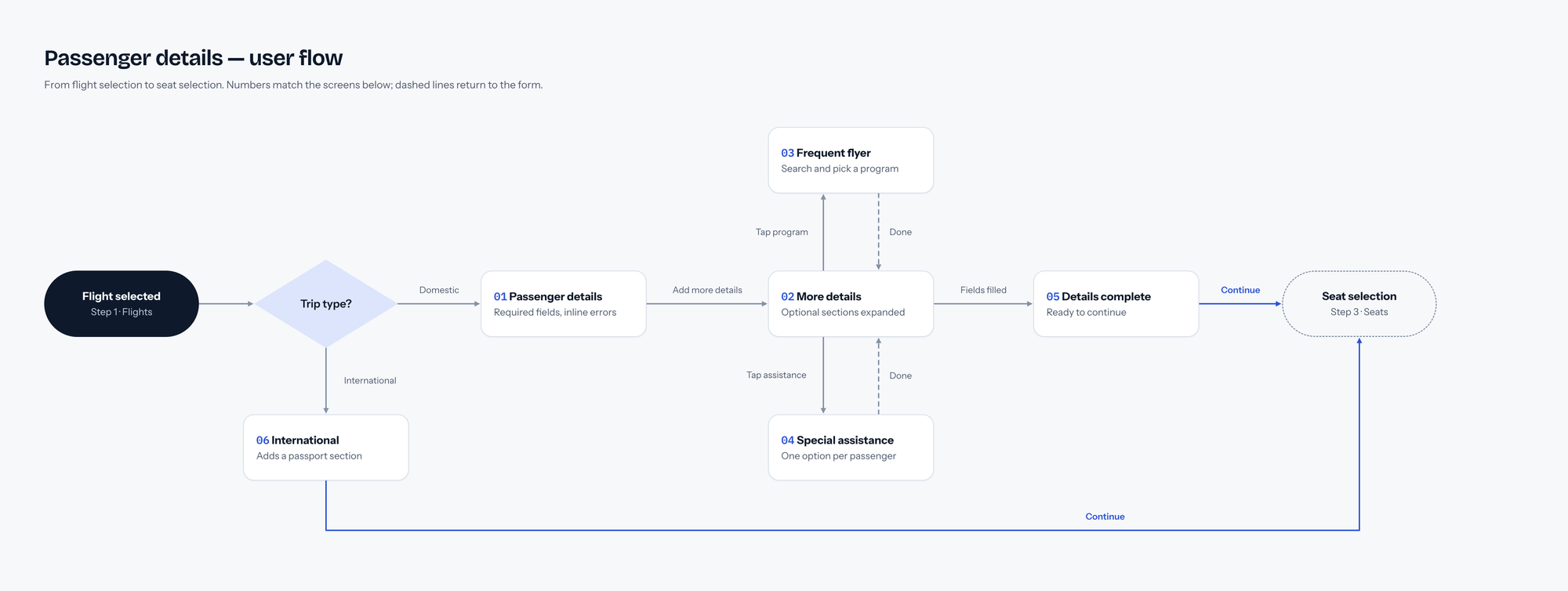
I designed the flight-booking experience with particular attention to scenarios that could not be handled through a single predetermined sequence.
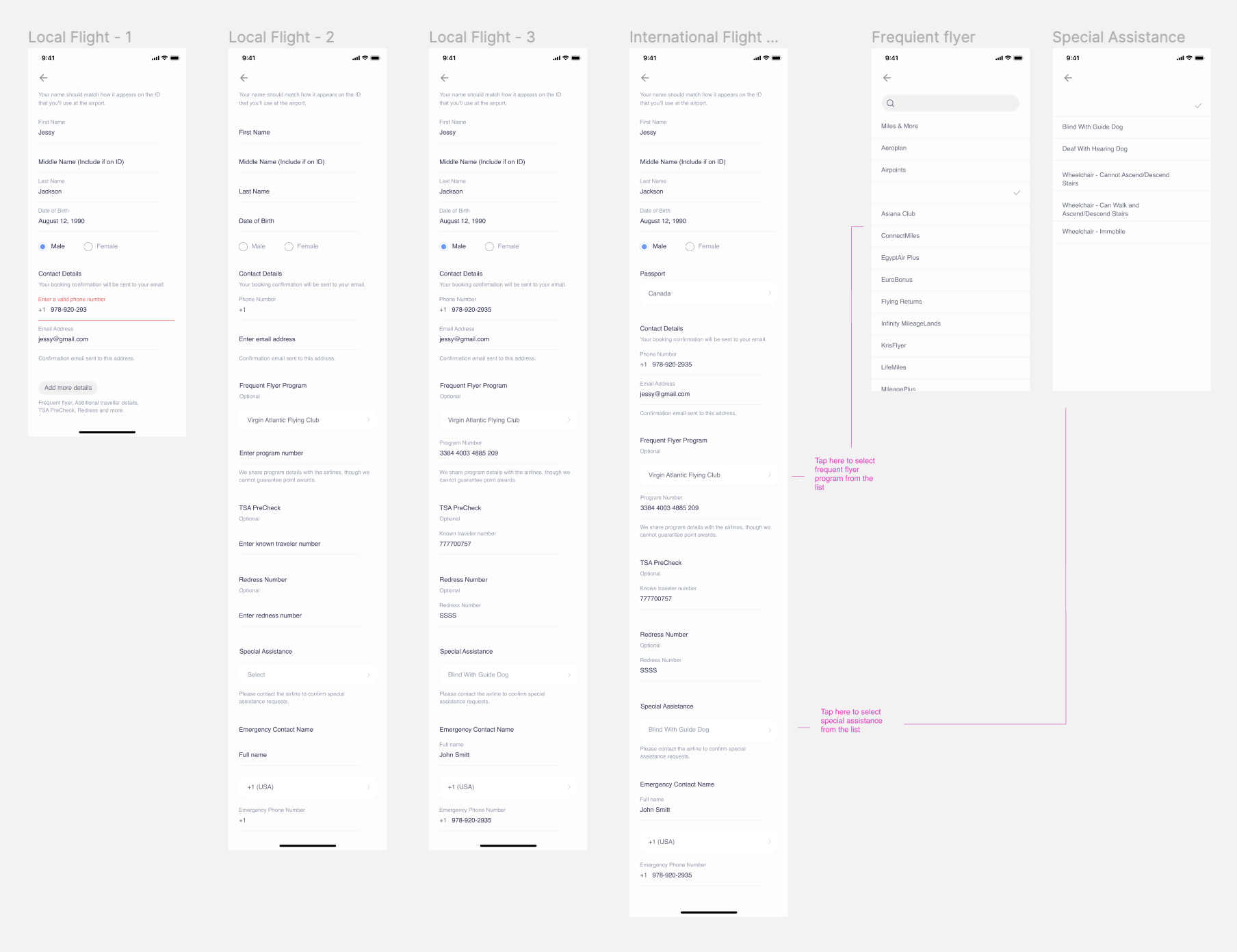
For example, domestic and international flights can involve different passenger information and travel requirements. Rather than treating every booking as an identical sequence of screens, the experience needed to accommodate variations in the information required at different stages.
I mapped these variations into user flows and created mid-fidelity designs covering the relevant states and interactions.
Designing reusable components across user journeys
Another important challenge was building an interface foundation that could support multiple use cases.
While flight booking, food ordering, and rideshare services serve different needs, they share many underlying interaction patterns.
Users express an intention, review available options, provide additional information, make selections, and confirm actions.
I considered component reusability from the earliest stages of designing these flows: instead of treating each user journey as an isolated experience, I explored how shared components and interaction patterns could be adapted to different scenarios.
This approach helped establish a scalable foundation for Natural's interface architecture and future design system.
The goal was to make dynamic interfaces feel like parts of one coherent product rather than a collection of unrelated applications.
The resulting experiences reused interface patterns across different tasks, helping maintain visual and interaction consistency while allowing the content and functionality to adapt to user intent.
If you look at the final design of Natural OS, you'll notice that many components are reused across different experiences, including scenarios such as food ordering (shared below)
And ordering taxi (shared below)
Defining success: from usability to product value
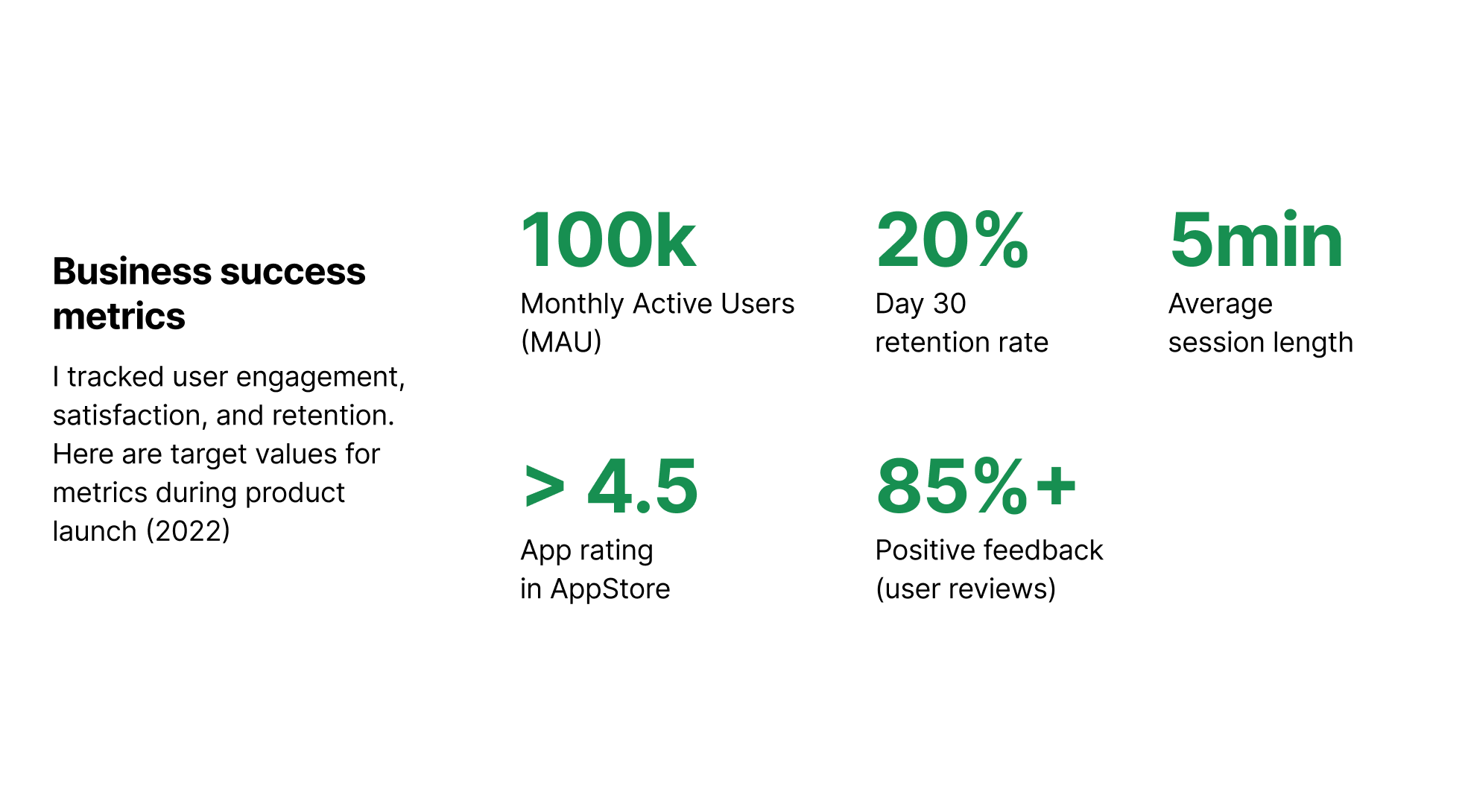
Beyond designing individual interactions, I worked closely with CEO Jerry Yue and CDO Gleb Kuznetsov to establish metrics for evaluating Natural's performance.
Our goal was to understand whether the product was not only easy to use but also valuable enough to become part of users' everyday routines.
We considered two complementary dimensions of success.
- Usability and Task Performance. Usability measures helped evaluate whether users could understand the new interaction model and successfully complete tasks. These included task completion, interaction effectiveness, and feedback gathered through usability testing.
- Product Value and Engagement. Because Natural introduced an unfamiliar approach to mobile computing, understanding long-term user value was essential. We used retention and positive-to-negative feedback measures to evaluate how users responded to the experience. Retention helped us understand whether users had reasons to return, while feedback highlighted areas where the experience met or failed to meet expectations.
These measurements informed our understanding of product value and supported ongoing product-design decisions.
Another important aspect of user flow design was optimising component reusability. When designing new components, it was essential to ensure they could be reused across different user flows.
I always considered the bigger picture when planning user flows, thinking about how the same component could work in different scenarios without requiring significant modifications.
Below are annual analytics results for Natural OS after a series of improvements that I've introduced to achieve better design consistency (styles, components and patterns) and design for edge cases:
| Metric | Before | After | Improvement |
|---|---|---|---|
| Task completion rate | 68% | 85% | +17 pp |
| Average time on task | 4m 20s | 3m 15s | −25% |
| Interaction errors per 100 tasks | 25 | 15 | −40% |
| Intent correctly interpreted on first attempt | 72% | 86% | +14 pp |
| Complex booking-flow completion rate | 55% | 75% | +20 pp |
| Tasks requiring user correction | 35% | 22% | −37% |
| Positive user feedback | 62% | 73% | +11 pp |
| Day 7 user retention | 18% | 24% | +6 pp |
| Day 30 user retention | 8% | 11% | +3 pp |
| Component reuse across designed journeys | 40% | 70% | +30 pp |
Outcome & Reflection
Natural launched as an iOS application in 2021 and received a 2022 Red Dot Design Award in the Mobile User Interface category.
The project gave me an opportunity to work on a product that challenged one of the most established conventions of mobile computing: the idea that users must navigate between separate applications to complete tasks.
My contribution extended beyond individual screens. I helped develop an interaction model, translate that model into complex consumer journeys, and establish reusable patterns and a measurement framework for the product.
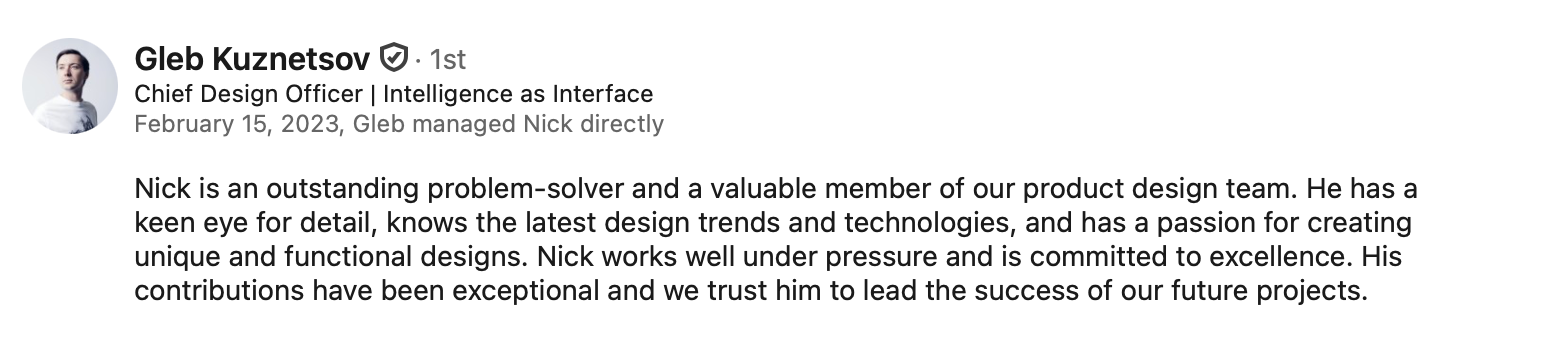
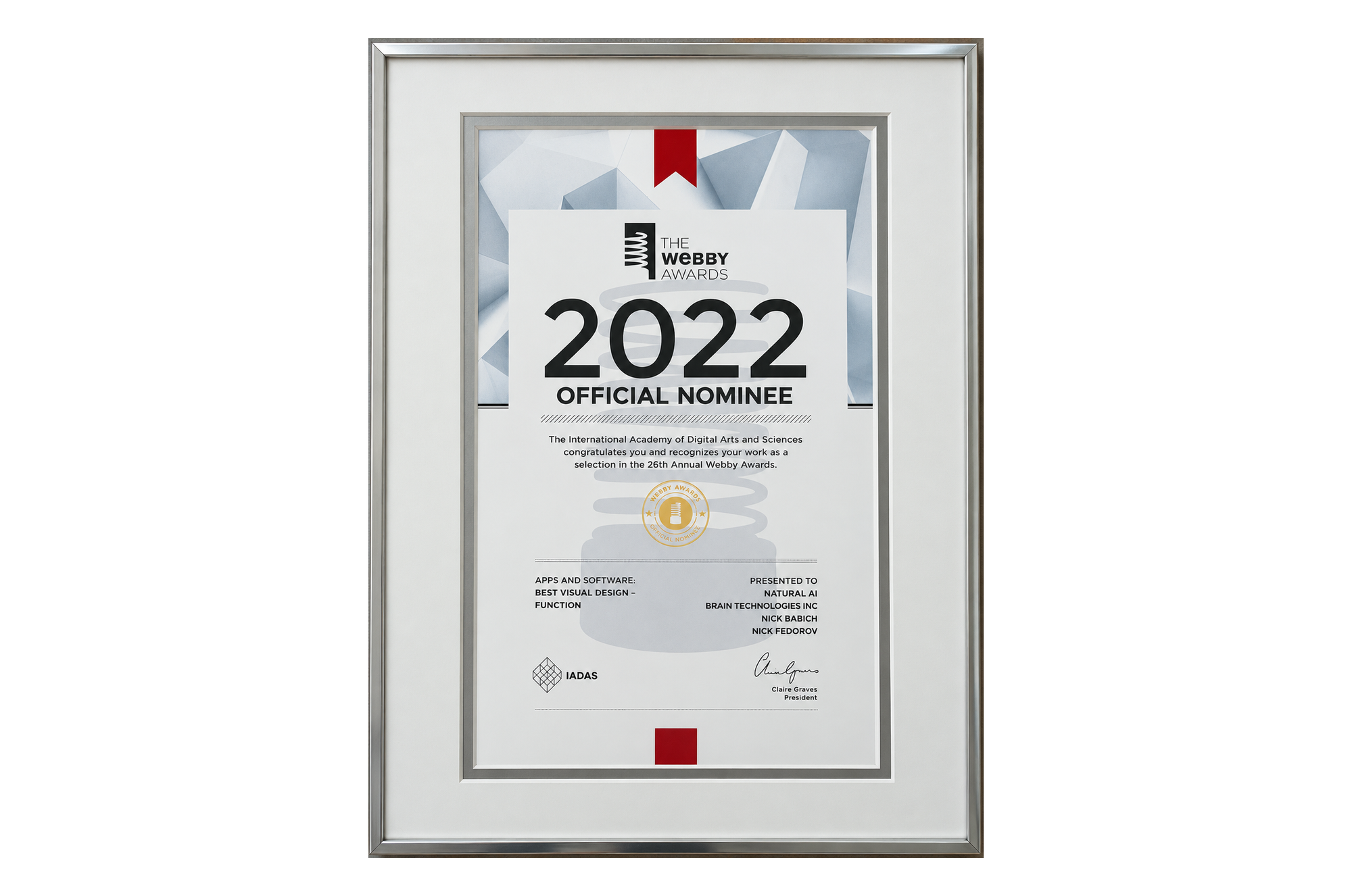
This contribution resulted in multiple awards, including Red Dot Award in 2022 for best mobile interface and the nomination for Webby Award from the International Academy of Digital Arts and Sciences (IADAS).
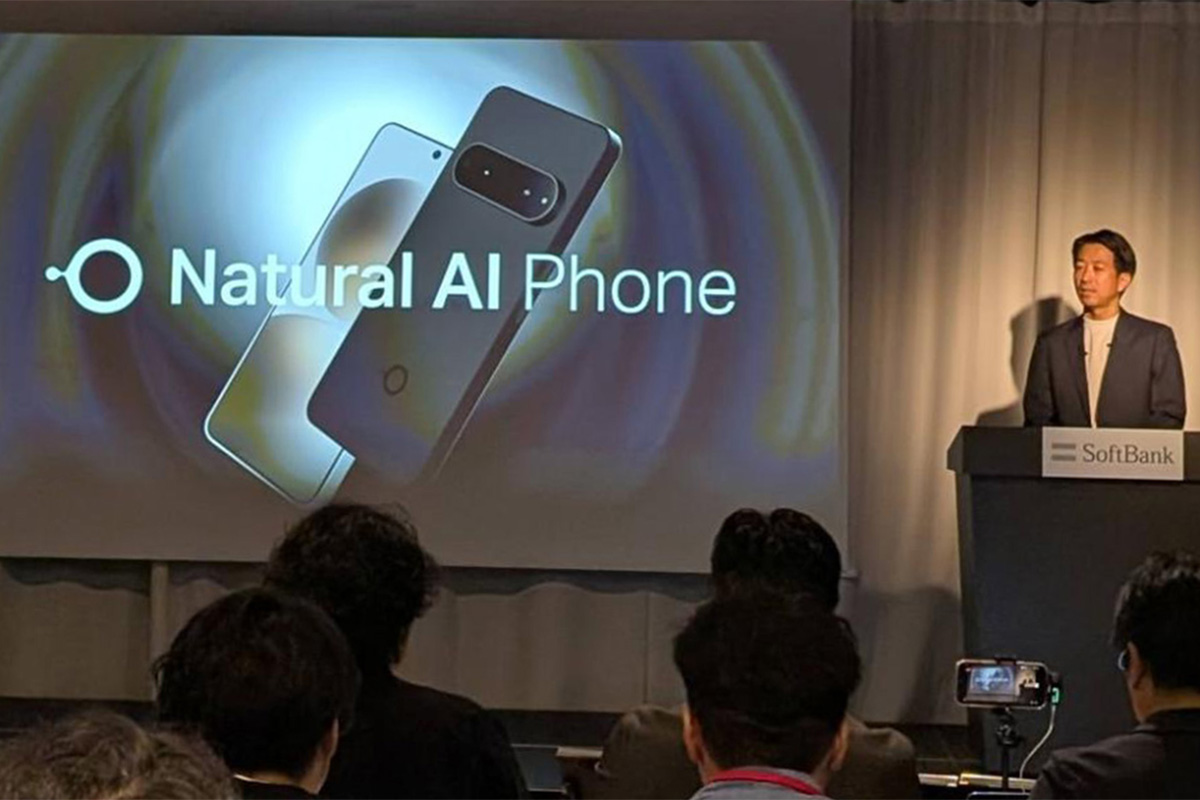
But what is even more important is that it lead to public release of the first AI Phone that Natural brought to the market in the of mid 2026 together with Softbank, one of the world's largest technology and investment conglomerates.